3/4 Sit-Up
Learn how to do the 3/4 sit-up with proper form to build stronger abs and improve hip flexor endurance.
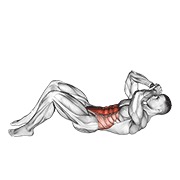 Watch animated demo (GIF)
How to perform
Lie flat on your back with your knees bent and feet flat on the floor, about hip-width apart. Place your hands behind your head with your elbows pointing outward, or cross them over your chest for a lighter version. Exhale and slowly curl your upper body off the ground, tucking your chin slightly and lifting until your torso reaches about a 45-degree angle. Pause briefly at the top, feeling your abs contract, then inhale and lower your upper body slowly back to the floor. Repeat for the desired number of reps, keeping the movement smooth and free of momentum.
Muscles worked
The 3/4 sit-up is a spinal-flexion movement that works your rectus abdominis through a long, deliberate range of motion. As you rise past the mid point, your hip flexors take on a bigger share of the load, while the lower back works to control the lowering phase.
- Abs — curl the torso up against gravity
- Hip flexors — assist as the torso approaches the top
- Lower back — slows and controls the descent
Make it easier
Cross your arms over your chest instead of holding your head, or anchor your feet under a couch so the hips stay down. Cutting the range to a shallow curl also reduces the load.
Make it harder
Hold a weight plate on your chest, pause for two seconds at the top of every rep, or lower with a three-second count. Keeping your feet unanchored while doing the full range adds a serious balance demand.
Common mistakes
- Mistake: Pulling on your neck to yank yourself up. Fix: keep your hands light and think of curling with your abs; your arms are just support.
- Mistake: Jerking up with momentum. Fix: rise slowly and pause at the top so every rep comes from muscle, not swing.
- Mistake: Dropping fast and slamming onto the floor. Fix: control the descent for at least two seconds.
FAQ
Why is it called a 3/4 sit-up?
Because you stop at about three quarters of the way up — a 45-degree angle — instead of sitting fully upright. The shortened range keeps tension on the abs while reducing stress on the lower back.
Are sit-ups bad for your back?
Done with control and a neutral spine, a 3/4 sit-up is fine for most healthy people. If you feel pinching in your lower back, anchor your feet or switch to crunches and dead bugs.