Bodyweight Standing Calf Raise
How to do bodyweight standing calf raises with proper form to build stronger calves, ankles and feet at home.
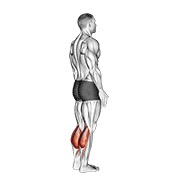 Watch animated demo (GIF)
How to perform
Stand tall with your feet shoulder-width apart and toes pointing forward. Place one or both hands on a wall or stable surface for balance. Brace your core, then rise up onto the balls of your feet as high as you can, squeezing your calves at the top. Pause for a moment, then lower your heels slowly and under control until you feel a comfortable stretch. Exhale as you rise and inhale as you descend, keeping your knees straight but not locked. Repeat for the desired number of reps.
Muscles worked
The standing calf raise targets the gastrocnemius, the large two-headed calf muscle that extends the ankle when your knee is straight, with the soleus underneath lending support. Your ankles and the small muscles of the feet work to keep you balanced through the full range.
- Calves (gastrocnemius and soleus) — lift your body onto the toes
- Ankles — control the joint through the full range of motion
- Feet — provide a stable base and push off the floor
Make it easier
Hold a wall or countertop with both hands for balance, or perform the raise while seated to shorten the lever. Reduce the range of motion slightly until your ankles feel stable.
Make it harder
Add a slow 2-second pause at the top and a 3-second lowering phase, do the raises one leg at a time, or stand with the balls of your feet on a step so your heels can drop below the toes for a deeper stretch.
Common mistakes
- Mistake: Bouncing at the bottom of the rep. Fix: lower your heels slowly and deliberately; momentum steals tension from the calves.
- Mistake: Rocking or using your legs to jerk upward. Fix: rise smoothly with the ankles only, keeping your knees still.
- Mistake: Letting your ankles roll inward. Fix: press evenly through the whole ball of the foot and keep your toes pointing forward.
FAQ
How many standing calf raises should I do?
Calves are very endurance-oriented, so aim for 15–25 controlled reps per set and take the last few reps to near failure. Train them 2–3 times per week alongside your lower-body days.
Do bodyweight calf raises actually build muscle?
Yes, especially in the early stages — your body weight is enough to overload the calves if you use a full range with a pause at the top and a slow lowering. Add a step or a backpack for more resistance later.