Dumbbell Lunge
How to do the dumbbell lunge with proper form to build glutes and quads
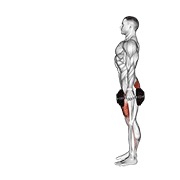 Watch animated demo (GIF)
How to perform
- Stand tall with your feet shoulder-width apart, holding a dumbbell in each hand at your sides.
- Take a controlled step forward with your right foot, planting the whole foot on the floor.
- Lower your body until both knees bend to about 90 degrees, keeping your torso upright and your chest lifted.
- Pause with your rear knee hovering just above the floor, then drive through your right heel to return to standing.
- Repeat the movement with your left leg, then alternate legs for the desired number of repetitions.
- Inhale as you lower, exhale as you push back up.
Muscles worked
The lunge is a single-leg compound movement: the glutes of the front leg power the push back to standing, while the quads, hamstrings and calves share the work and the core keeps you balanced.
- Glutes — extend the hip of the front leg and drive the ascent
- Quadriceps — extend the knee and control the lowering phase
- Hamstrings — stabilize the knee and assist the glutes
- Calves — keep the ankles and foot stable on the floor
Make it easier
Put the dumbbells down and do bodyweight lunges first, take a shorter step, or brace one hand against a rack for balance. Reducing the depth also makes the movement easier to control.
Make it harder
Hold heavier dumbbells, slow the lowering phase to three seconds, or pause at the bottom of each rep. You can also step onto a slightly elevated platform to increase the range of motion.
Common mistakes
Mistake: Letting the front knee cave inward. Fix: push the knee out and keep it tracking in line with the toes. Mistake: Taking too short a step so the knee shoots past the toes. Fix: lengthen the stride and push through the heel of the front foot. Mistake: Leaning forward from the waist. Fix: keep the torso tall and the chest up, bracing the core. Mistake: Pushing off the back foot instead of the front. Fix: drive through the front heel to power the return to standing.
FAQ
What is the correct lunge stride length?
Take a stride long enough that your front knee stays above your ankle at the bottom of the movement. A step that is too short loads the knee, while an overly long one turns the exercise into a hip stretch.
Do lunges build the glutes or the quads more?
Both — the glutes work hard on the leading leg while the quads control the descent. A longer stride shifts emphasis toward the glutes, while a shorter, more vertical stance favors the quads.