Hyperextension
How to do hyperextensions with proper form to build a strong lower back
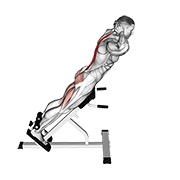 Watch animated demo (GIF)
How to perform
- Adjust the hyperextension bench so the pad sits under your upper thighs and your ankles are secured under the foot rests.
- Cross your arms over your chest or place your hands behind your head.
- Inhale and lower your upper body toward the floor with a straight back, folding only at the hips.
- Pause briefly when you feel a stretch in the hamstrings and lower back.
- Exhale and raise your torso back up until your body forms a straight line with your legs.
- Repeat for the desired number of repetitions.
Muscles worked
The hyperextension is a hip-hinge movement for the posterior chain: the erector spinae hold the torso in place through the fold, while the glutes and hamstrings power the return to a straight line.
- Erector spinae — extend the spine and control the descent
- Glutes — extend the hips and lift the torso at the top
- Hamstrings — assist hip extension and stabilize the knees
Make it easier
Shorten the range of motion so you only lower partway, or rest your hands on your chest instead of behind your head to lighten the load. A less angled bench also reduces the difficulty.
Make it harder
Hold a weight plate or dumbbell against your chest, pause for two seconds at the top, or slow the lowering phase to a three-second count. Single-leg hyperextensions are an advanced option for extra challenge.
Common mistakes
Mistake: Arching the lower back too far at the top. Fix: stop when your body is in a straight line and squeeze the glutes instead of overextending. Mistake: Rounding the spine on the way down. Fix: keep the back flat and hinge from the hips only. Mistake: Using momentum and bouncing at the bottom. Fix: lower slowly and pause before lifting. Mistake: Rushing the raise and swinging the torso. Fix: keep a steady tempo and drive the hips forward consciously.
FAQ
Is the hyperextension bad for your back?
No — performed with control and a neutral spine, it strengthens the lower back safely. Avoid bouncing at the bottom and do not arch the spine past a straight line with your legs at the top.
What muscles do hyperextensions work?
They target the erector spinae along the spine, with the glutes and hamstrings assisting as you rise. It is a hip-hinge movement that builds the posterior chain without heavy spinal compression.