Russian Twist
Learn the russian twist with proper form to strengthen your abs and obliques with a bodyweight rotation.
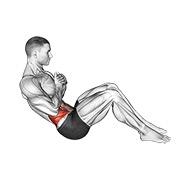 Watch animated demo (GIF)
How to perform
Sit on the floor with your knees bent and feet flat, then lean your torso back until you feel your abs engage while keeping your spine long. Clasp your hands together in front of your chest or hold a light weight. Lift your feet off the ground and balance on your sit bones, keeping your chest up and shoulders relaxed. Rotate your torso to the right, bringing your hands toward your right hip, and pause. Rotate through the center and twist to the left, keeping the movement in your ribs rather than your arms. Breathe steadily and alternate sides for the desired number of reps.
Muscles worked
The russian twist trains rotational core strength: your obliques rotate the ribcage while your rectus abdominis works isometrically to hold your torso in its leaned position. The balancing position also forces your deep core muscles to fire constantly.
- Abs — hold the torso at an angle and brace the spine
- Obliques — power the rotation side to side
- Hip flexors — support the seated balancing position
Make it easier
Keep both feet planted on the floor while you twist, or cross your arms and rotate only your shoulders. Reducing the lean of your torso also lowers the demand on your core.
Make it harder
Lift your feet higher, straighten your legs slightly, or hold a weight at your chest. You can also slow the tempo and pause at each side, or perform the twist without letting your feet touch the floor between reps.
Common mistakes
- Mistake: Rounding the lower back while twisting. Fix: sit tall with your chest open and rotate from the ribs, not the spine.
- Mistake: Swinging the arms instead of turning the torso. Fix: keep your hands fixed at your chest — the movement should come from your obliques.
- Mistake: Holding your breath for the whole set. Fix: exhale as you twist to each side and inhale through the center.
FAQ
Should I hold weight while doing russian twists?
Only after you can do 15 clean bodyweight reps with your feet off the ground and a flat back. Start with a light plate or medicine ball held at your chest — never swing a heavy weight at speed.
Why do my hips cramp during russian twists?
Your hip flexors hold your torso at an angle, so they fatigue quickly when your abs are weak. Keep your feet on the floor while you build strength, and sit tall to reduce the hip-flexor workload.