Walking Lunge
How to do the walking lunge with proper form to strengthen glutes and legs
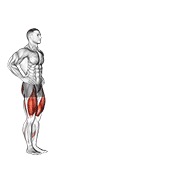 Watch animated demo (GIF)
How to perform
- Stand tall with your feet shoulder-width apart and your hands on your hips or hanging at your sides.
- Step forward with your right leg and lower your body into a lunge, keeping your torso upright.
- Check that your front knee stays above your ankle as your rear knee drops toward the floor.
- Push off with your right foot and bring your left foot forward, stepping directly into the next lunge.
- Keep alternating legs and walking forward at a steady, controlled pace.
- Inhale on each descent, exhale as you step through, and repeat for the desired number of repetitions.
Muscles worked
The walking lunge trains each leg unilaterally while moving, so the glutes and quads of the leading leg control the descent and drive the step, with the hamstrings and calves supporting and the core resisting rotation.
- Glutes — extend the hip of the leading leg and power the step-through
- Quadriceps — control the knee through the full range
- Hamstrings — stabilize the knee and assist hip extension
- Calves — drive the push-off and keep the ankle stable
- Core — keeps the torso upright between steps
Make it easier
Practise stationary lunges first to build the pattern, or hold onto a wall or rack with one hand for balance. Taking smaller steps also reduces the demand on balance.
Make it harder
Hold a dumbbell in each hand or a barbell across your back, add a two-second pause at the bottom of every lunge, or slow the tempo so each step takes a full three seconds.
Common mistakes
Mistake: Rushing between steps and losing control. Fix: keep a steady pace, planting each foot fully before stepping forward. Mistake: Letting the front knee drift inward. Fix: push the knee out and keep it in line with the toes. Mistake: Leaning the torso forward as you tire. Fix: keep the chest up and brace the core for the whole set. Mistake: Stepping too short so the front knee juts past the toes. Fix: lengthen the stride so the knee stays stacked over the ankle.
FAQ
How many walking lunges should you do per set?
Start with 8 to 10 steps per leg, keeping the tempo steady and the torso tall. Increase the step count as your balance improves, and add weight only once bodyweight reps feel easy.
What is the difference between walking and stationary lunges?
A walking lunge adds a forward step-through, so each leg works while you balance in motion. That extra stability demand trains the core and ankles harder than a stationary lunge.